Research question
Can candidate Electronic Voice Phenomena be recorded independently of a person hearing or suggesting phrases in real time?
MTC is designed primarily to test whether EVP-like recorded results occur when NO human observer is present in the monitored test area during acquisition.
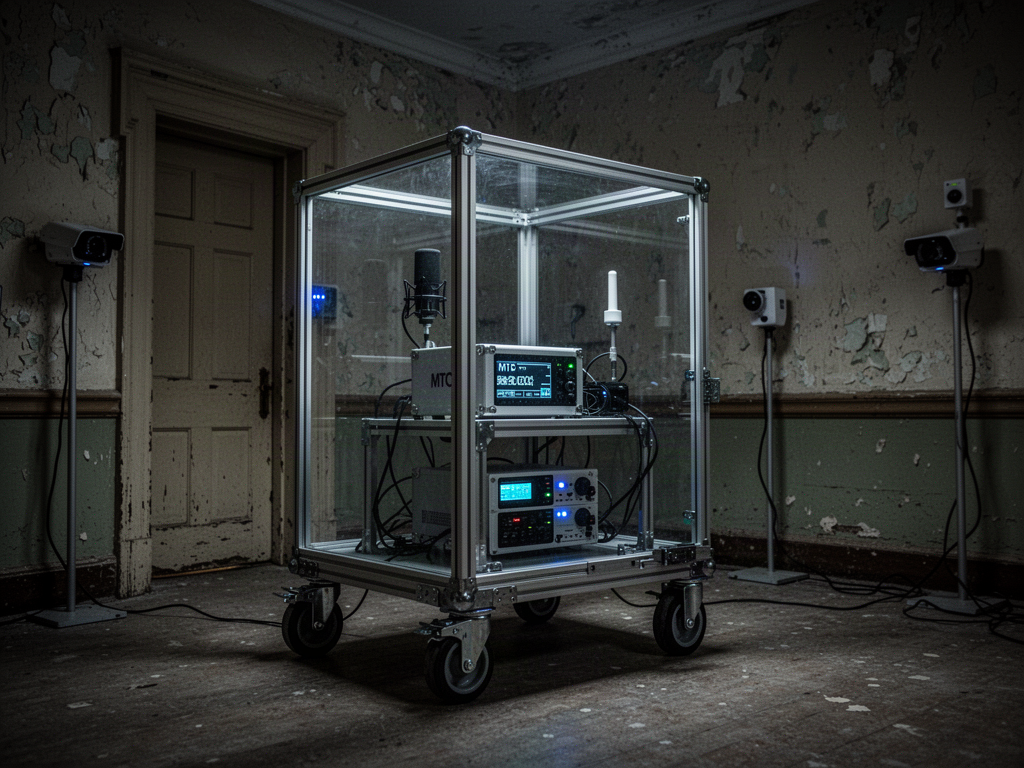
Can candidate Electronic Voice Phenomena be recorded independently of a person hearing or suggesting phrases in real time?
Establish acoustic and environmental baselines; clear the monitored test area; capture unattended, synchronized audio and video; preserve originals; use blinded post-session listening and matched control sessions.
Investigate external voices, HVAC, plumbing, radio interference, recorder self-noise, digital artifacts and the influence of suggested words on reviewers.
An apparent phrase is a candidate event for controlled retesting, not evidence by itself of a paranormal source.
A Windows desktop running the VEIL MTC v0.1.2 bench prototype automatically played 11 prerecorded spoken questions through Realtek desktop speakers while a HyperX SoloCast USB microphone continuously captured room audio. The researcher left the room for the unattended acquisition period.
Questions were played in filename order without a person in the monitored room. The procedure used 15-second post-question listening intervals.
The session finished automatically. The researcher replayed the saved microphone WAV and confirmed the question audio was captured acoustically.
The review utility returned PASS_WITH_MANUAL_REVIEW_REQUIRED. Manual playback was confirmed by the researcher; this does not replace independent assessment.
Initial playback, recording, storage and unattended sequencing were demonstrated. Long-duration reliability, independent recorder corroboration, acoustic controls and blinded response evaluation remain outstanding.
VEIL has selected MTC as the first priority for a modest research-methods pilot, with planned milestones through January 8, 2027. The October 10 plan called for equipment inventory, acoustic contamination controls, preliminary calibration and an independently reviewable protocol before formal research recordings. Initial engineering bench recordings were subsequently completed October 23; scientific controls remain under development. Original recordings will be preserved, and post-recording evaluation will be blinded without suggested phrases.
The October 10 planning document was not evidence of a tested system. Subsequent bench testing demonstrates basic audio operation only; the prototype has not been independently endorsed or found to detect an anomaly. View the proposed milestones and offer technical critique ↗
These are requirements and decision criteria to develop—not completed validation or an indication that all four gates have been passed.
Previous EVP and ITC work used blinded controls, including Boccuzzi and Beischel (2011). Its limitations and null findings must be addressed.
Audio recording and human speech perception are established; a paranormal EVP source is not. AI transcription can falsely recognize words in noise.
Preregister event thresholds and compare unattended recordings to equipment-only and matched controls, with independent blind listener judgments and agreement statistics.
If candidate event rates and listener agreement fail to exceed matched controls, report that result and stop implying a distinct anomalous source.
VEIL’s planned instruments share a common emphasis: synchronized measurement, rigorous controls, raw evidence preservation and transparent review.
Contact · Collaborate · Support →