Virtual model
The research concept includes a 196-sensor virtual configuration and an initial 1.5°C event threshold, subject to calibration.
A proposed distributed thermal measurement grid. Interpretation of moving patterns or volumetric shapes requires validation and independent physical references.
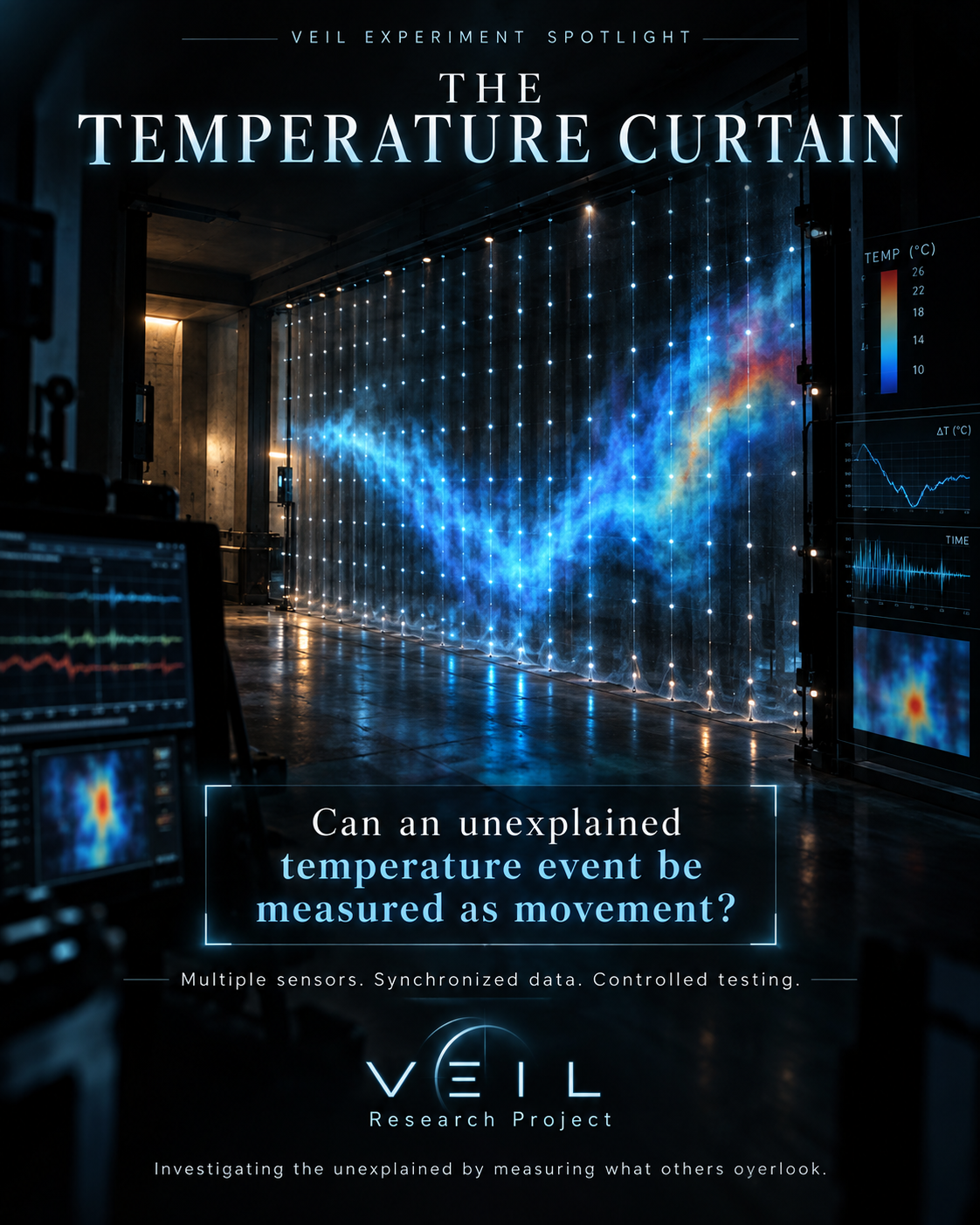
The research concept includes a 196-sensor virtual configuration and an initial 1.5°C event threshold, subject to calibration.
Use controlled heat and cold sources, track trailing patterns and assess effects from HVAC, people, equipment and room geometry.
Correlate sensor maps with reference thermal imaging and conventional temperature sources.
These are requirements and decision criteria to develop—not completed validation or an indication that all four gates have been passed.
Thermal arrays and distributed temperature monitoring predate VEIL. A specific sensor-network prior-art review remains to be completed.
Sensors measure temperature at their own positions. Reconstructing three-dimensional body-shaped volumes would require validated spatial models and independent references.
Compare a small array with calibrated known hot/cold sources and reference imaging. Prespecify time lag, location error, drift and false-alarm performance.
Do not scale up unless controlled disturbances can be localized and airflow, equipment heating and sensor faults can be distinguished.
VEIL’s planned instruments share a common emphasis: synchronized measurement, rigorous controls, raw evidence preservation and transparent review.
Contact · Collaborate · Support →